Siesta Key Condo Prices Are Splitting in Two, and the Median Won't Tell You Which Side You're On
A buyer goes under contract on a two-bedroom near the north end of Siesta Key. The number looks right, the view is real, the inspection comes back clean. Then the estoppel certificate lands in the file two weeks before closing and it mentions a special assessment nobody discussed at the showing. Depending on the building, that line item can run anywhere from a few thousand dollars to well past $60,000 per unit. The lender asks a question the buyer wasn't prepared for. The deal either survives a hard renegotiation or it doesn't.
That scenario is playing out across the island this year, and it's the reason the headline number everyone quotes about Siesta Key condos is less useful than it looks. The median price is falling. That part is true. What it hides is that the island's condo stock has split into two markets that sit on the same streets, sometimes in buildings a block apart, and the median blends them into one misleading figure.
Special assessments on Siesta Key condos generally run $2,000 to $10,000 for routine capital work. In older or underfunded buildings, they climb to $25,000, $40,000, or beyond $60,000 per unit when concrete restoration, roof replacement, or storm damage is involved. Buildings that took on hurricane-related repairs have seen owners assessed $10,000 or more just to cover a master policy's wind deductible, separate from the cost of the repair itself.
The timing is what catches buyers off guard. These figures often surface after a contract is signed, buried in board minutes or a reserve study the buyer didn't think to request until the estoppel arrived. A building with a pattern of frequent, large assessments doesn't just cost the current owner. It can push the entire building toward a non-warrantable classification, meaning conventional lenders won't touch it and the buyer pool shrinks to cash and portfolio-loan buyers only. That single detail can end a financed deal in the last two weeks before closing.
Zillow's index, updated through June 2026, puts the average Siesta Key home value at $825,673, down 5.4% from a year earlier. Redfin's tracking for the three months ending May 2026 shows a median sale price of $899,000, down 12.6% year over year.
Here's the detail that gets skipped: over that same period, Redfin's price per square foot for Siesta Key actually rose 6.7%. A falling median alongside a rising price per square foot is not a sign that Siesta Key is worth less. It's a sign that the mix of what's selling has changed. Older, larger, discount-priced units in assessment-burdened buildings are moving in greater numbers and pulling the median down, while the price per square foot for well-maintained inventory keeps climbing. The island isn't losing value. Its condo stock is being sorted.
Sarasota County condos carried roughly 8.1 months of supply as of March 2026, comfortably in buyer-leaning territory. But that supply isn't spread evenly. Buildings with completed reserve studies and healthy funding are pricing close to list. Buildings still working through Florida's structural compliance requirements are the ones sitting longer and cutting price.
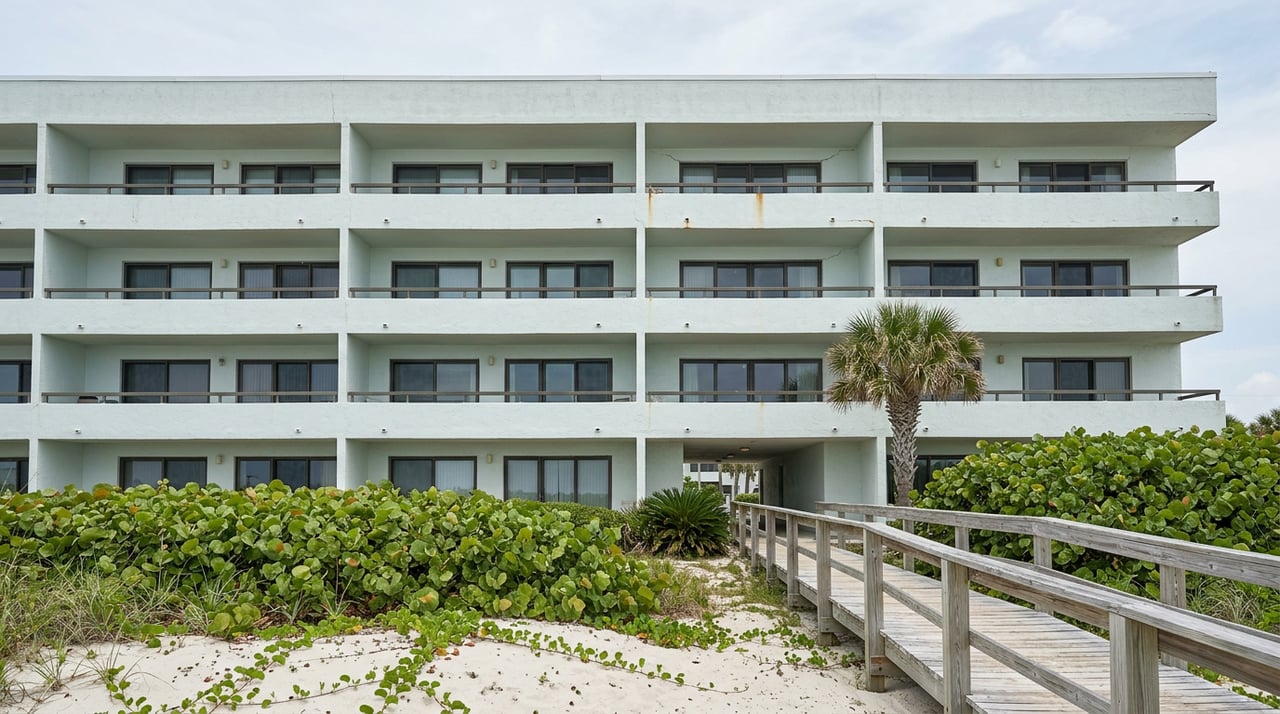
Siesta Towers, a 12-story building on the island's north end within walking distance of Siesta Key Village, was completed in 1973. At 53 years old this year, it is squarely inside the age range where milestone inspections and reserve funding schedules are already in force, and buildings of that vintage are the ones most likely to be issuing the special assessments buyers are discovering in escrow. Mid-rise buildings along the Midnight Pass Road corridor showed price declines in the 10 to 20 percent range year over year in market reporting covering the end of 2025, with longer time on market to match.
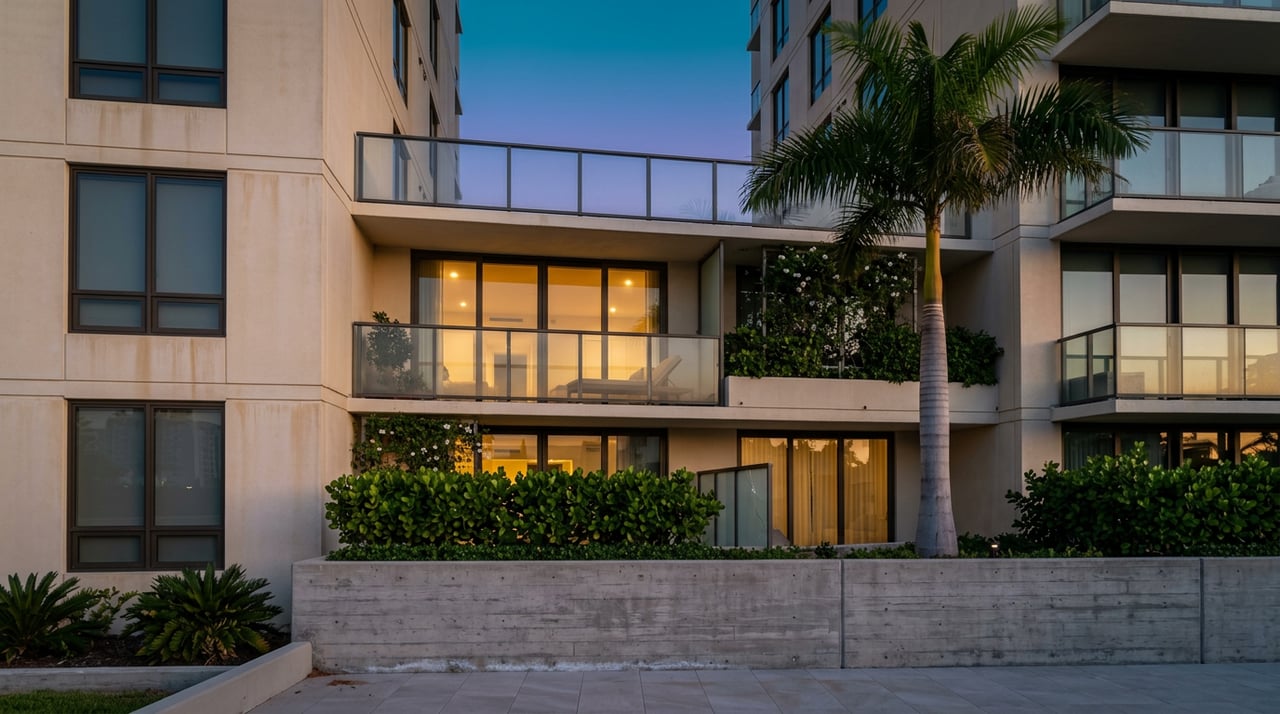
Compare that to Siesta Key Beach Residences, the beachfront tower on Beachside Drive built in 2009. At 17 years old, it is nowhere near the 30-year milestone trigger, and even under the accelerated 25-year coastal timeline it would not face a first inspection until 2034. Same island, same hurricane exposure, a completely different paperwork profile for at least another eight years.
| Building profile | Typical era | Compliance status | Recent price behavior |
|---|---|---|---|
| Pre-1980s low-rise or mid-rise (Siesta Towers, Midnight Pass Road corridor) | 1970s–1980s | Already inside the milestone and SIRS funding window, some with disclosed assessments | Down roughly 10–20% year over year |
| Newer beachfront tower (Siesta Key Beach Residences, built 2009) | Late 2000s | Not due for a first milestone inspection until 2034 at the earliest | Pricing closer to list |
The address doesn't tell you which column you're in. The building's certificate of occupancy date and its reserve study do.
Florida's condo reforms, passed after the Champlain Towers South collapse and refined through Senate Bill 4-D, Senate Bill 154, and House Bill 913, used to let associations vote to waive or underfund reserves. That loophole closed for good starting with any budget adopted on or after January 1, 2025. Associations that had previously waived reserves were required to begin funding them on the reserve study's schedule as of January 1, 2026. Milestone inspections and the companion Structural Integrity Reserve Study, or SIRS, are due by December 31, 2026 for buildings that trigger the requirement, generally three stories or taller and 30 years old, or 25 years in some coastal jurisdictions. The full breakdown of deadlines and what a SIRS actually evaluates is laid out on the state's own condo inspection resource page.
What that means in practice: a board can no longer keep monthly dues artificially low by skipping reserve contributions. The true cost of a fifty-year-old building's aging roof, plumbing, and concrete has to show up somewhere. It shows up as higher dues, as a special assessment, or as a lower sale price when the seller can't find a buyer willing to absorb the gap. Right now, across older Siesta Key buildings, it's showing up as all three at once.
Before writing an offer on a Siesta Key condo, the file that matters more than the listing photos is the association's paperwork:
None of this appears in the MLS listing. It has to be requested directly from the association, and the earlier in the process it's requested, the less likely a buyer is to lose an inspection period and a deposit over something that should have surfaced on day one.
For beachfront and near-beach properties in the 34242 zip code, buyers should budget separately for wind and hurricane coverage, typically $10,000 to $30,000 or more annually depending on construction and mitigation features, and flood insurance, generally $5,000 to $15,000 depending on zone and elevation. A base homeowners policy on a coastal property can add another $5,000 to $15,000. For a condo, the building's master policy matters just as much as individual unit coverage, since a poorly insured association passes its exposure directly to owners through assessments.
Cash purchases made up more than 40% of Sarasota County sales as of late 2025 reporting, which is part of why financing risk doesn't deter every buyer on the island. For anyone using a mortgage, though, the non-warrantable question, tied to reserve health, pending litigation, or rental restrictions, deserves an answer before an offer goes in, not after an appraisal comes back.
Out-of-state buyers from New York, New Jersey, Illinois, and California are leading the inbound migration into Gulf Coast Florida, with more than $126 million in purchases by out-of-state buyers recorded in the first sixty days of 2026 alone. Many of them are comparing Siesta Key against other barrier islands and against mainland Sarasota, using the median price as their first filter.
That filter misses the point this year. The better comparison isn't Siesta Key against another neighborhood. It's one building's file against another's, on the same block. A lower price on an older building isn't a discount if the reserve study shows a six-figure assessment two years out. A higher price on a newer tower isn't a premium if it buys two decades of insulation from that exact risk.
Does a lower price mean a better deal on an older Siesta Key condo? Not automatically. If the savings on the purchase price are smaller than the assessment or dues increase already documented in the reserve study, the lower price isn't actually lower.
Can I request the reserve study before making an offer? Yes. Associations with 25 or more units are now required to post governing documents, budgets, and reserve studies under recent transparency rules, and any association should provide them on request. Getting that file before writing an offer, rather than after, is the difference between negotiating from strength and negotiating under a deadline.
Siesta Key hasn't gotten less desirable. Its condo market has gotten more specific, and the number on the portal doesn't reflect that. If you're weighing a building on this island, Arlene Buckmaster reviews the reserve study, the milestone report, and the board minutes before you fall for the view, so the only surprises left are the ones you'd actually want. Let's Connect.


Lakewood Ranch




5208 ASHLEY PKWY SARASOTA, FL 34241